




























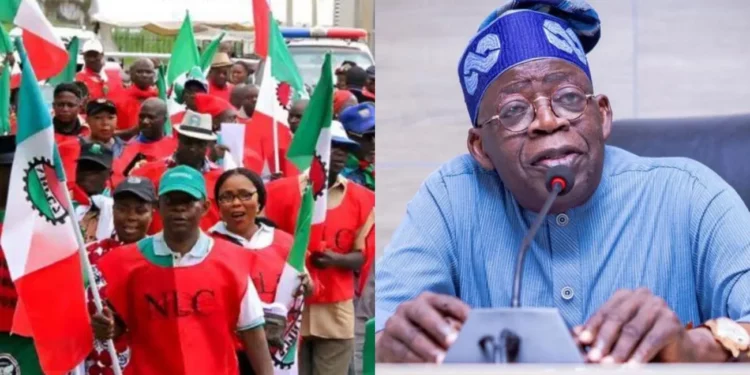
Developing: NLC, FG Workers Push for Upward Review of ₦70,000 Minimum Wage Amid Rising Inflation
Developing: NLC, FG Workers Push for Upward Review of ₦70,000 Minimum Wage Amid Rising Inflation

••as 10 States Cross Benchmark
The Nigeria Labour Congress (NLC) and federal government workers have renewed calls for an urgent upward review of the national minimum wage, stressing that the current ₦70,000 benchmark can no longer sustain the average worker.
Eagles Sight News gathers that this fresh and developing demand follow recent decisions by several state governments to raise the wages of their employees above the ₦70,000 level in response to worsening economic conditions.
Workers and labour leaders who spoke with the News Agency of Nigeria (NAN) in separate interviews explained that the rising costs of food, housing, transportation, and other essential services have made it nearly impossible to survive on ₦70,000. They argued that the minimum wage, introduced just over a year ago, has already been eroded by inflation.
It will be recalled that in July 2024, President Bola Tinubu signed into law the National Minimum Wage Bill, which increased the wage from ₦30,000 to ₦70,000. The legislation was designed to cover workers in the federal, state, and local governments, as well as the private sector.
However, since the law came into effect, several states have taken steps to raise salaries beyond this benchmark. On August 27, 2025, Governor Hope Uzodinma of Imo State approved a new minimum wage of ₦104,000 for civil servants. The governor explained that the adjustment, agreed upon in consultation with organised labour, was aimed at improving workers’ welfare.
Prior to Imo’s announcement, other states had also reviewed their minimum wage. On October 16, 2024, Governor Babajide Sanwo-Olu of Lagos State raised the minimum wage to ₦85,000 and pledged to increase it further to ₦100,000 in 2025. Rivers State followed on October 18, 2024, approving ₦85,000, while Bayelsa, Niger, Enugu, and Akwa Ibom set theirs at ₦80,000. Ogun and Delta States pegged the wage at ₦77,000, Benue and Osun agreed to ₦75,000, while Ondo approved ₦73,000.
Speaking on the development, Acting General Secretary of the NLC, Mr. Benson Upah, said the value of the ₦70,000 minimum wage had been badly weakened by inflation, leaving workers struggling to survive.
“The truth is that ₦70,0000 is not sustainable under the present economic situation. Workers are under immense pressure, and unless the government responds quickly, the crisis of survival will only worsen.
We have since engaged the Federal Government on this matter at different times and forums. It is our hope that the government would see both the economic and moral obligations to do so expeditiously,” he said.
He noted that while the NLC remains committed to dialogue, the option of industrial action could not be ruled out if negotiations fail. Upah further urged workers to remain united and actively involved in union activities to strengthen the collective fight for fair wages.
Similarly, the President of the Association of Senior Civil Servants of Nigeria (ASCSN), Mr. Shehu Mohammed, commended the governors who had reviewed the wages of their workers, describing the move as both encouraging and instructive.
According to him, the actions of the states should serve as a clear message to the Federal Government.
“Right from the beginning, during the negotiation, our demand was for a living wage, and we submitted ₦250,000 as a reasonable benchmark.
We told the government that anything short of that only takes a worker to the gate of the office, not back home,” he said.
Mohammed emphasised that with soaring costs of electricity, transport, and food, ₦70,000 no longer holds value.
“Let’s be realistic. Even if you pay electricity bills out of ₦70,000, what remains cannot sustain a family for 10 days,” he added.
He urged the Federal Government not only to review wages but also to adopt broader social and economic policies that would make life easier for Nigerians, including affordable housing, accessible healthcare, and subsidised transport.
Federal government workers also shared their struggles with NAN.
Mrs. Kemi George, a civil servant, expressed frustration over the economic hardship.
“By the time I pay transport to work and buy food, nothing is left. Rent and school fees are almost impossible to cover. It is only God that has been sustaining us because our take-home pay is nothing compared to what we spend in a month,” she said.
Another worker, Mr. Obi Chimaobi, described the situation as unbearable, noting that many families were already in dire conditions.
“Things are no longer affordable. A bag of rice is now like gold, transport fares keep rising daily, and with ₦70,000, you are already in debt before the month even ends.
The Federal Government must act very fast in reviewing workers’ wages. The federal government must also recognise that reviewing the minimum wage is not merely about appeasing labour unions.
It is about restoring dignity to work and reaffirming the social contract between government and the governed,” he added.
For Mrs. Bola Akingbade, another civil servant, improving workers’ welfare would not only help their families but also enhance service delivery.
“A well-paid workforce is a motivated workforce,” she said.
She stressed that financial security reduces the temptation of corruption and drives higher productivity in ministries, departments, and agencies.
On his part, Mr. Jeremiah Okon argued that the federal government should take a cue from the states already paying above ₦70,000, despite having smaller revenue bases.
He suggested that the wage be increased to at least ₦150,000 nationwide.
“Increased wages will percolate through increased spending on goods and services, thereby stimulating local businesses and boosting the economy,” Okon said.
He maintained that salary adjustments should not be seen as a financial burden but as an investment in economic recovery.
(NAN)