



























































































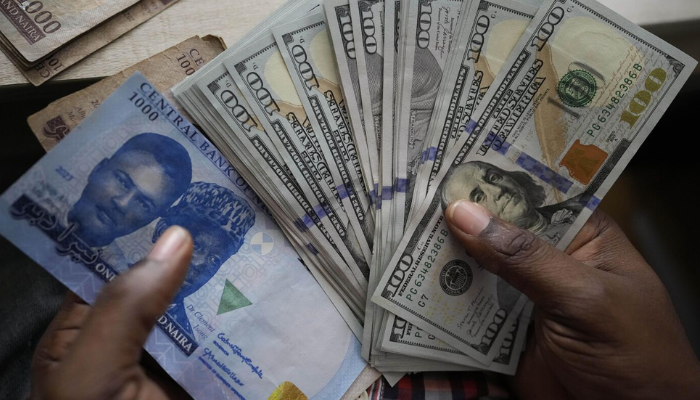
Naira Under Fire: Falling Reserves and Slow Inflows Bite Currency
Naira Under Fire: Falling Reserves and Slow Inflows Bite Currency
The naira continued to lose value in the official foreign exchange (FX) market on Tuesday, as reduced capital inflows and a steady fall in Nigeria’s foreign reserves increased pressure on the local currency amid rising tensions in the Middle East.

According to the Central Bank of Nigeria (CBN), the naira weakened by N5.87, with the dollar trading at N1,386.66 on Tuesday, up from N1,380.79 recorded on Thursday before the Easter holiday at the Nigerian Foreign Exchange Market (NFEM).
In a report gathered on by Eaglessightnews on BusinessDay In the parallel market, the local currency moved in the opposite direction, appreciating by N5 to close at N1,405 per dollar from N1,410 on Thursday. The gap between the official and parallel markets narrowed to N19 per dollar from N30 per dollar recorded last week.
External reserves, which provide the Central Bank with firepower to support the currency, declined for the 13th consecutive session, falling by about $840 million to $49.18 billion as of April 1 from $50.02 billion recorded on March 11, according to CBN data.
The persistent drawdown reflects mounting external pressures tied to heightened geopolitical tensions in the Middle East, which analysts say have dampened investor appetite for frontier markets and weakened capital inflows into Nigeria.
Even though March data is not yet available, foreign portfolio investment (FPI) inflows on the FMDQ FX market stood at $1.6 billion in January and $1.9 billion in February. However, March is expected to reflect a slowdown, largely due to the impact of the Middle East conflict on investor sentiment, an analyst said under anonymity.
Despite firmer crude oil prices, the naira has yet to benefit significantly from Nigeria’s position as an oil exporter. Analysts note that the currency weakened by an average of 1.80% in March, reflecting softer crude production levels and increased domestic allocation of oil to local refineries, a trend that may be limiting foreign-exchange earnings from exports.
Nigeria’s FX stability came under renewed strain in March as global risk aversion and declining capital inflows combined to pressure the currency, underscoring the economy’s exposure to external shocks, according to analysts in the financial services sector.
Read also: [Naira ends week flat as reserves post 13-day losing streak](https://businessday.ng/news/article/naira-ends-week-flat-as-reserves-post-13-day-losing-streak/?amp)
Reports by Afreximbank, Quest Merchant Bank and FMDA indicate that Nigeria and other African economies have faced renewed FX pressures linked to the ongoing Middle East conflict.
According to Quest Merchant Bank, the naira depreciated by about 1.3 percent month-on-month to close at N1,387 per dollar in March 2026, reversing the relatively stronger performance recorded in the first two months of the year as FX liquidity tightened across the market.
Afreximbank data showed the naira trading at N1,390.2 per dollar compared to N1,353.4 in February 2026, while still stronger than the N1,558.7 level recorded a year earlier.
“African foreign exchange markets came under renewed pressure in March 2026, with the majority of currencies recording month-on-month depreciation against the U.S. dollar. This trend reflects a confluence of external shocks and underlying structural vulnerabilities, reinforcing the continent’s sensitivity to global financial and commodity cycles,” Afreximbank said in its report.
The report identified escalating geopolitical tensions in the Middle East as a key driver, noting that the crisis triggered a pronounced flight to safety into U.S. dollar-denominated assets. The dollar’s safe-haven appeal was further reinforced by rising global risk aversion and heightened uncertainty in energy markets, even as oil prices climbed.
Quest Merchant Bank analysts attributed the naira’s weaker performance primarily to a sharp drop in offshore investor participation driven by geopolitical uncertainty.
“The naira came under renewed pressure due to tight FX liquidity resulting from dwindling offshore investor inflows,” the analysts said. “The ongoing conflict in the Middle East has triggered a global risk-off sentiment toward emerging market assets, including Nigeria.”
They added that foreign investors have largely adopted a cautious stance. “Foreign investors have largely remained on the sidelines, choosing to monitor the duration and potential escalation of the Middle East conflict,” the report noted.
The retreat of offshore investors is particularly significant for Nigeria, where foreign portfolio inflows play a critical role in supporting FX liquidity. Reduced participation has tightened supply conditions further, amplifying pressure on the currency.
In its latest report, FMDA said global currency movements point to tightening financial conditions. The U.S. dollar strengthened broadly against major currencies, with the euro and pound declining by 2.2% and 1.9% respectively, while commodity-linked currencies such as the Australian and New Zealand dollars fell more sharply by 3.0% and 4.2%
Notably, the dollar also gained against traditional safe-haven currencies, rising by 1.7% against the Japanese yen and nearly 4.0% against the Swiss franc, suggesting that the current environment reflects not only risk aversion but also a broader repricing of global interest rates and inflation expectations in favour of the U.S. currency.
Emerging market currencies have similarly come under pressure, as reflected in the depreciation of the Turkish lira, South African rand and the Nigerian naira, reinforcing the impact of global shocks on vulnerable economies.
Source: BusinessDay